
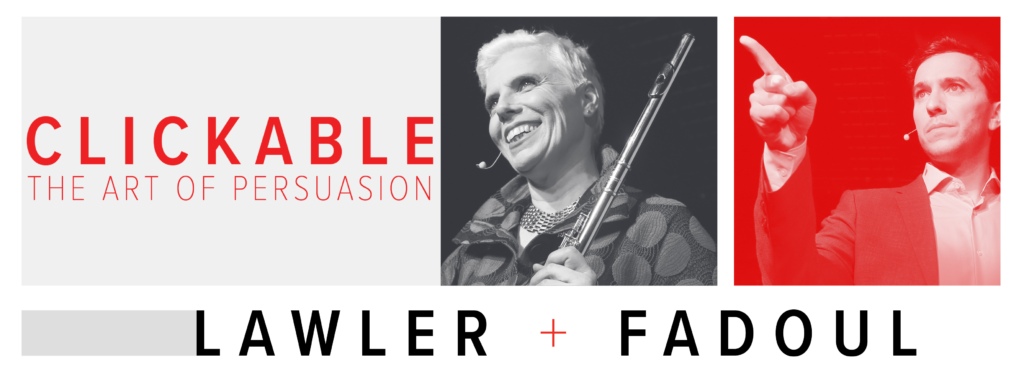
 This Spring, Lawler + Fadoul, the duo of flutist Zara Lawler and marimbist Paul J. Fadoul formally launch and celebrate their second album Clickable: The Art of Persuasion, released earlier this year on Ravello Records, an imprint of PARMA Recordings. The album is the foundation of their theatrical concert that explores both the “music and words of persuasion.” With powerful storytelling, the album masterfully conveys both positive and negative angles of coercion, pressure, manipulation, and coaxing with virtuosic instrumentals, song, and theatrical text.
Clickable deals with timely issues of propaganda, self-promotion and social media, and the power of music to create community. At a time when many people are at home consuming media, one can become unaware of the persuasive language entering our consciousness daily. Clickable both calls attention to that phenomenon, and provides an antidote through fun, rich, and complex music making.
The album includes: a spoken-word commentary on social media (Click. Tweet. Like. Repost., with words by poet Liza Jessie Peterson); dust jacket texts set to music (one of the books being Power Money Fame Sex, from the self-help satire book of the same name by Gretchen Rubin), — plus a lullaby, a protest song, a serenade, and four commercial jingles.
“I always thought it would be cool to do a show that had live commercial breaks! And then once we started to think of jingles as this incredibly American artform of persuasive music, it just expanded into these other kinds of persuasive music.”
—Zara Lawler
Clickable includes commissioned works by Canadian composer Jason Nett, American composer Ralph Farris, and hip-hop poet Liza Jessie Peterson. Comprised of studio and concert hall recordings, and one live track, the theatrical bent of Clickable is presented in the audio-only experience by way of different sound environments, sound effects, layering, and unusual instrumentation. Beyond the core of flute and marimba, Lawler + Fadoul’s fresh arrangements of folk and baroque composers plays with a palette of vocals, dulcimer, washboard, and even boxes of candy used as maracas.
Clickable was incubated and debuted at nancy nanocherian’s the cell theatre.
Please note: A previously announced performance which was to be held this Spring at the Leonard Nimoy Thalia Theatre at New York’ Symphony Space will be rescheduled for Fall 2020.
For more about Lawler + Fadoul, please visit lawlerandfadoul.com
To inquire about a physical or digital review copy,
please write to [email protected]
 Like most people of Jewish heritage today, I come from a family of immigrants and refugees. My mother’s family fled from their homeland, Bulgaria, during WW2 to escape the Nazis. They did so by taking trains through the Balkans, Turkey, Syria and Lebanon. Miraculously they all arrived safely in the Middle East. My father’s family was less fortunate. His parents met in Germany in 1945 in a Displaced Persons camp established by the U.S and the United Nations. Having lost nearly all of their family members, both of them were alone and had nowhere to go. The Americans settled them in an apartment in Regensburg, Germany. And there my father was born. I often think of their years in Germany – living among the Germans including former Nazis… not knowing where they would end up, trying to rebuild their broken lives. Once Israel became established, they emigrated there.
 I suppose you all have noticed for a while that I am an immigrant. What you may not know is that my father is a Hungarian Jew. He and his family were ve
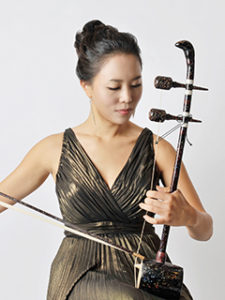
 My grandfather, O’Wagon Yelanjian, fled Turkey as a teenager around 1908 to escape the massacre of Armenians in Turkey. He came alone, and was sponsored by a stranger. During WW1 he served in the U.S. Army. After the war, my grandfather’s sponsor in Wisconsin wanted his Armenian fiancée to emigrate to the U.S. She wouldn’t come without her best friend… and that was my grandmother, Angele Djivelekian. She married my grandfather without knowing him. She was from Constantinople and brought her oud with her. I recall her playing it for me, using a feather to strum the strings. They went on to have two sons. When those children (my father and uncle) started elementary school, they knew no English. As a reaction to his difficult early school years, my father didn’t teach us to speak Armenian. However, my grandparents lived next door and there was a large population of Armenians in the area who formed a community. This colored and enriched my early years.
 I have always been proud to be the daughter of an immigrant. But only recently have I begun to understand just how proud I should be. When my father came to the U.S. at the age of 27, he already knew about 4-5 languages – but English was not one of them. Though he had been a journalist and translator in Europe, he quite willingly took some clerical and menial jobs in his first year in America. He worked briefly in a shoe store, a deli, and as an elevator operator. But within 5 years, he had mastered English so well that he was working as a journalist again – this time for an arts and culture newspaper in San Francisco.


You must be logged in to post a comment.