
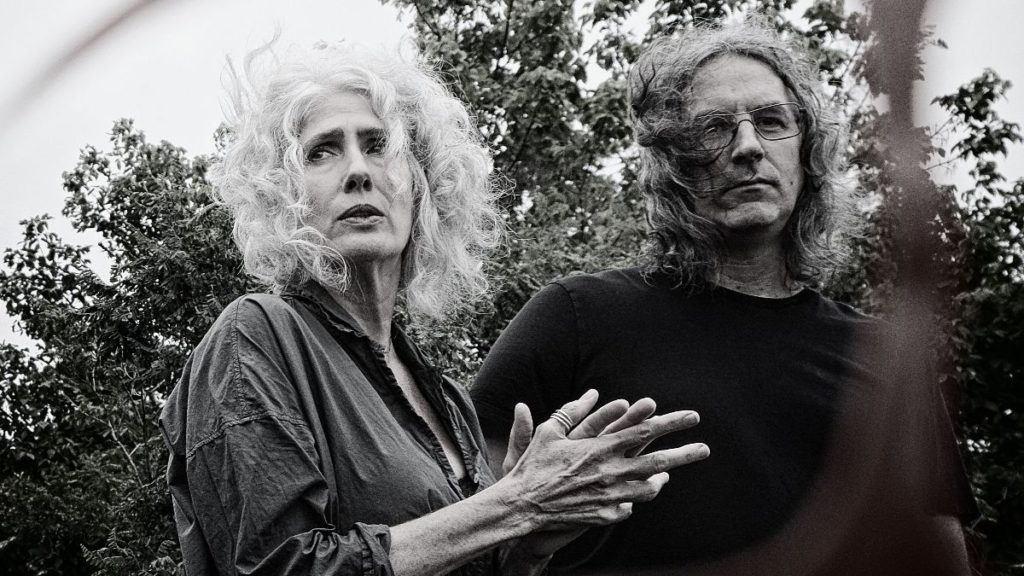
This year, Toronto-based vocalist Fides Krucker‘s first foray into improvisatory composition Vanishing is released in the United States and internationally on guitarist Tim Motzer’s own 1k Recordings imprint.
Made up of spontaneous compositions, the album finds the musical unit of Krucker and Motzer exploring six surreal, melancholic, and emotionally charged tracks they dub as ‘lost worlds’ and ‘sonic films’. Born of five days of improvisation in 2017 in a Philadelphia heatwave, Vanishing’s six tracks are intended to present wordless stories and ‘conversations’ between the musician’s organic interplay. Of the compositional process, Motzer notes that, “[regardless of] the choice of a key or mode, the parameters of loops, or microphones; it did not take much for one of us to begin and the other to follow. Twice—when one voice was not enough—Fides added a second improvised line.”
Vanishing opens with the brief “Scintilla”: Krucker’s voice sings with crystal clarity on simple vocables, as Motzer’s plaintive guitar crawls in, and the song comes to a natural, grieving crescendo. Throughout the rest of the album, Krucker continues to masterfully present various haunting colors from her voice: hums, lilt, sob, twang, fry, chant, breaks, drones, and operatic wails that veer into glossolalia. She evokes the broad kinship of other vocal pioneers like Patty Waters, Cathy Berberian, and Lisa Gerrard — all while maintaining her own identity.
Similarly exploratory is Motzer, who sympathetically uses prepared guitar, e-bow, and electronic elements to ensure an immersive, otherworldly soundtrack. On the title track “Vanishing”, he uses reversed sounds and a Spanish-like guitar feel for a beautiful underlay; whereas on “Ruins” and “Eema”, both artists weave unnerving but engaging dark, synthetic atmospheres with real-time loops and modification.
New York-based drummer Jeremy Carlstedt joins the duo on both “Density” and the title track, adding sensitive textural support throughout. Of “Density”, Krucker says, “it was made after a conversation about Trump — that’s why it is so heavy — and that was Summer 2017. Things are so much worse now. There is a grieving in the album and a sharing of culture…”
Advanced praise from a previously limited Canadian release of Vanishing comes by way of Innerviews, where Anil Prasad paints Krucker’s voice as both “lovely” and “elastic” — and All About Jazz, whose Geno Thackara boldly glows, “Fides Krucker’s voice is less an instrument than a force of nature.” The Whole Note’s Andrew Timar also described the album as “cinematic in scope”, pegging the musicianship as “superb”. Timar also quips, “some days taking a walk on the sonic wild side is what the doctor should order.”
Vanishing is now available for download and streaming on Bandcamp: https://1krecordings.bandcamp.com/album/vanishing
A special CD pressing is also available, signed by the artists. The CD is limited to 200 copies, and includes an 8” x 12” poster. Photography for the album was provided by Avraham Bank, and designed by Yesim Tosuner of Backyard Design.
Works on the album are:
1 Scintilla・2 Vanishing・3 Ruins・4 Rime・5 Density・6 Eema
For more about the artists, please visit fideskrucker.com and timmotzer.com
To inquire about a physical or digital review copy,
please write to [email protected]
 This Spring,
 Like most people of Jewish heritage today, I come from a family of immigrants and refugees. My mother’s family fled from their homeland, Bulgaria, during WW2 to escape the Nazis. They did so by taking trains through the Balkans, Turkey, Syria and Lebanon. Miraculously they all arrived safely in the Middle East. My father’s family was less fortunate. His parents met in Germany in 1945 in a Displaced Persons camp established by the U.S and the United Nations. Having lost nearly all of their family members, both of them were alone and had nowhere to go. The Americans settled them in an apartment in Regensburg, Germany. And there my father was born. I often think of their years in Germany – living among the Germans including former Nazis… not knowing where they would end up, trying to rebuild their broken lives. Once Israel became established, they emigrated there.
 I suppose you all have noticed for a while that I am an immigrant. What you may not know is that my father is a Hungarian Jew. He and his family were ve
 My grandfather, O’Wagon Yelanjian, fled Turkey as a teenager around 1908 to escape the massacre of Armenians in Turkey. He came alone, and was sponsored by a stranger. During WW1 he served in the U.S. Army. After the war, my grandfather’s sponsor in Wisconsin wanted his Armenian fiancée to emigrate to the U.S. She wouldn’t come without her best friend… and that was my grandmother, Angele Djivelekian. She married my grandfather without knowing him. She was from Constantinople and brought her oud with her. I recall her playing it for me, using a feather to strum the strings. They went on to have two sons. When those children (my father and uncle) started elementary school, they knew no English. As a reaction to his difficult early school years, my father didn’t teach us to speak Armenian. However, my grandparents lived next door and there was a large population of Armenians in the area who formed a community. This colored and enriched my early years.
 I have always been proud to be the daughter of an immigrant. But only recently have I begun to understand just how proud I should be. When my father came to the U.S. at the age of 27, he already knew about 4-5 languages – but English was not one of them. Though he had been a journalist and translator in Europe, he quite willingly took some clerical and menial jobs in his first year in America. He worked briefly in a shoe store, a deli, and as an elevator operator. But within 5 years, he had mastered English so well that he was working as a journalist again – this time for an arts and culture newspaper in San Francisco.


You must be logged in to post a comment.