Humanity First: We Are All In This Together

Jenny Q Chai incorporates her exceptional artistry with striking visual elements, including NASA data visualizations, to highlight climate change and COVID-19 challenges. Includes two Bay Area premieres.

Sponsored by San Francisco’s Ross McKee Foundation and featured as part of their Piano Break series, Bay Area and Shanghai based pianist Jenny Q Chai will perform a free evening length concert on Friday, May 7, 2021 at 5:00 pm, Pacific time (8:00pm Eastern time).

This concert will last under an hour and will be broadcast by way of rossmckeefoundation.org/event/jenny-chai-2021-05-07. Pre-registration is not required.

At the conclusion of every Piano Break, the audience can meet the artist and ask questions in a live Zoom Green Room: rossmckeefoundation.org/zoom .


Entitled Humanity First: We Are All In This Together, the concert includes the following works:

Jarosław Kapuściński — Oli’s Dream
György Ligeti — Musica Ricercata No.1 with NASA global warming data visualizations
György Ligeti — Musica Ricercata No.7 with NASA global warming data visualizations
Milica Pavlovic* — Paranosic Bubble (in trouble) with bubble machine and lights
Stephen Sondheim — Into the Woods (arrangement by Andy Akiho)
(with paintings by Camryn Connolly)
Jarosław Kapuściński — Side Effects, with photography by Kacper Kowalski

This will be Ms. Chai’s first solo virtual concert, her first concert designed during the Covid-19 pandemic in the U.S. and her first concert in 2021. *Work by Pavlovic is a Bay Area Premiere.

In Chai’s words, “Globally, we are experiencing the same kind of difficulties, and yet trying to survive, to adapt, to thrive and to hold on to hope. It is a heightened time for us to remember to unite together as earthlings. We must take care of our earth, global health systems, strategizing, communications and planning, in order to survive together.” Last year, Chai gave a TEDx talk, When Classical Music Meets Technology. Chai believes that art needs to reflect the current state of our world, and to raise awareness in people about social issues.


For many years, Chai has been creating thematic programs for issues to reflect our current society, such as her global warming program Acqua Alta which she toured and performed for six years. The works in the May 7th concert by Ligeti, Pavlovic and Kapuschinski’s Side Effects originate from this program. Chai’s performance of the Ligeti works use NASA’s data visualization on global warming’s effect on water. Side Effects is an AI interactive intermedia piece with visuals shot by aerial photographer/pilot Kacper Kowalski, about the earth as its seasons change from summer to winter. The remaining works address humanity: Oli’s Dream is also AI interactive, as it types out a poem about our hopes and dreams with tenderness. The Into the Woods arrangement mirrors how Chai felt about the messiness of being in the US during the pandemic under the Trump administration. 


For more about Jenny Q Chai, please visit jennychai.com
For more about the Ross McKee Foundation, visit rossmckeefoundation.org

In October 2020, New York City based Composer David Claman is releasing his new album, Gradus, on Albany Records. A thirteen track collection of new recordings of compositions and interpretations from throughout Claman’s whole career, Gradus borrows from a canyon of inspirations: from Indian Classical to electronic experimentation. The album also gathers performances from several celebrated musicians, including India’s singing priest Paul Poovathingal, twice GRAMMY®-nominated flutist Tara Helen O’Connor, New York’s New Thread Saxophone Quartet, guitarist-composer Steve Mackey, and vocalist Sunita Vatuk, Claman’s wife and collaborator.

Loose Canons II opens the album as a preview towards the end, where it is reprised in more movements, taking as its model Johannes Ockeghem’s Missa Prolationum. Here, a continuous three-part composition is presented by three electric guitars with sustain devices, leading into an interpolation of Jimi Hendrix, before completely dissolving the canon.

The one-minute track Brit finds Claman narrating a famous passage from Herman Melville’s Moby Dick, surrounded by an unlikely ensemble of computers, cellphones, toys, CD players, microwaves, all recorded with a telephone tap. Claman conjures Melville’s allegorical ‘sea of the human soul’ with his own ‘ocean’ of electromagnetic sounds.  Literary allusions continue in both From a Dream and Rescue The Dead, featuring soprano Elizabeth Farnum singing the text of the late American poet David Ignatow. Claman again finds joy in contradiction, nuance, existentialism, and importantly, open interpretation — a concept that he takes in the aptly titled Liberties Taken. There, the New Thread Quartet plays through Tiruvottiyur Tyagayya’s Sahana Raga Varnam, adding in newly arranged elements, while preserving much of the work’s original character.

With musicians and inspirations from all walks of life, Gradus presents a throughline in Claman’s work that he says, “speaks to each other across decades, continents, and centuries of shared influences.” Claman, a self-described ‘hard-core atheist’ adds nevertheless that the works evoke “an underlying and unspoken yet certain spirituality. Just in time for our very uncertain world.”


For more about David Claman, please visit davidclaman.com

To inquire about a physical or digital review copy,
please write to [email protected]

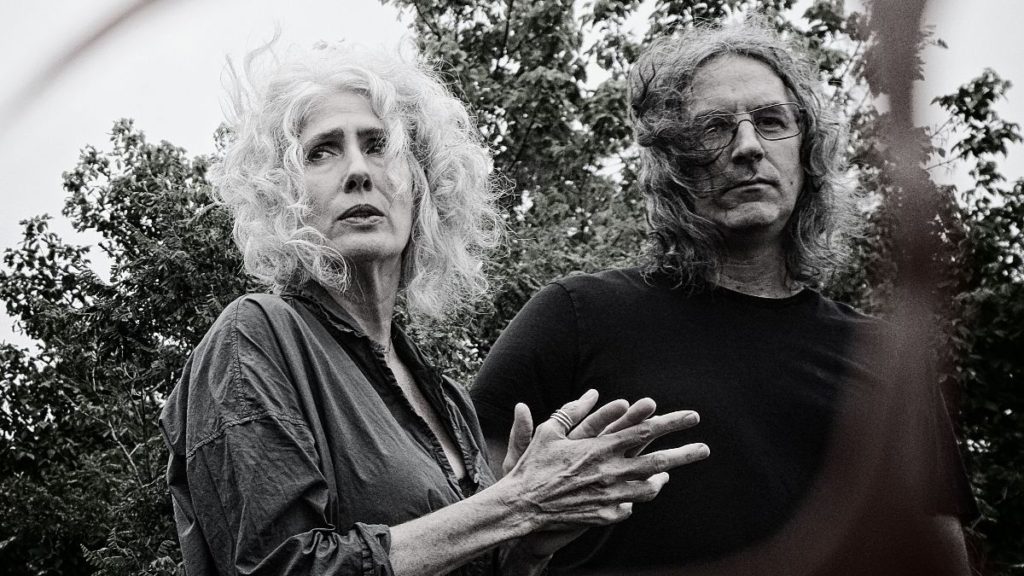
This year, Toronto-based vocalist Fides Krucker‘s first foray into improvisatory composition Vanishing is released in the United States and internationally on guitarist Tim Motzer’s own 1k Recordings imprint.

Made up of spontaneous compositions, the album finds the musical unit of Krucker and Motzer exploring six surreal, melancholic, and emotionally charged tracks they dub as ‘lost worlds’ and ‘sonic films’. Born of five days of improvisation in 2017 in a Philadelphia heatwave, Vanishing’s six tracks are intended to present wordless stories and ‘conversations’ between the musician’s organic interplay. Of the compositional process, Motzer notes that, “[regardless of] the choice of a key or mode, the parameters of loops, or microphones; it did not take much for one of us to begin and the other to follow. Twice—when one voice was not enough—Fides added a second improvised line.”


Vanishing opens with the brief “Scintilla”: Krucker’s voice sings with crystal clarity on simple vocables, as Motzer’s plaintive guitar crawls in, and the song comes to a natural, grieving crescendo. Throughout the rest of the album, Krucker continues to masterfully present various haunting colors from her voice: hums, lilt, sob, twang, fry, chant, breaks, drones, and operatic wails that veer into glossolalia. She evokes the broad kinship of other vocal pioneers like Patty Waters, Cathy Berberian, and Lisa Gerrard — all while maintaining her own identity. 

Similarly exploratory is Motzer, who sympathetically uses prepared guitar, e-bow, and electronic elements to ensure an immersive, otherworldly soundtrack. On the title track “Vanishing”, he uses reversed sounds and a Spanish-like guitar feel for a beautiful underlay; whereas on “Ruins” and “Eema”, both artists weave unnerving but engaging dark, synthetic atmospheres with real-time loops and modification.

New York-based drummer Jeremy Carlstedt joins the duo on both “Density” and the title track, adding sensitive textural support throughout. Of “Density”, Krucker says, “it was made after a conversation about Trump — that’s why it is so heavy — and that was Summer 2017. Things are so much worse now. There is a grieving in the album and a sharing of culture…”


Advanced praise from a previously limited Canadian release of Vanishing comes by way of Innerviews, where Anil Prasad paints Krucker’s voice as both “lovely” and “elastic” — and All About Jazz, whose Geno Thackara boldly glows, “Fides Krucker’s voice is less an instrument than a force of nature.” The Whole Note’s Andrew Timar also described the album as “cinematic in scope”, pegging the musicianship as “superb”. Timar also quips, “some days taking a walk on the sonic wild side is what the doctor should order.”


Vanishing is now available for download and streaming on Bandcamp: https://1krecordings.bandcamp.com/album/vanishing

A special CD pressing is also available, signed by the artists. The CD is limited to 200 copies, and includes an 8” x 12” poster. Photography for the album was provided by Avraham Bank, and designed by Yesim Tosuner of Backyard Design.

Works on the album are:
1 Scintilla・2 Vanishing・3 Ruins・4 Rime・5 Density・6 Eema


For more about the artists, please visit fideskrucker.com and timmotzer.com

To inquire about a physical or digital review copy,
please write to [email protected]

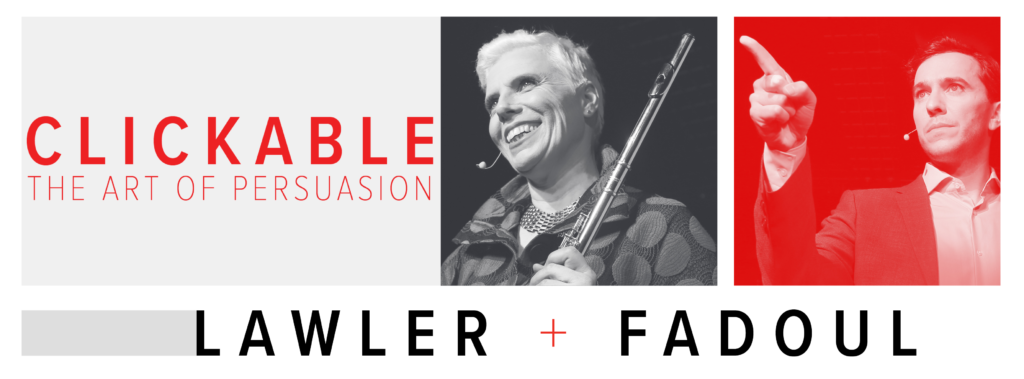
This Spring, Lawler + Fadoul, the duo of flutist Zara Lawler and marimbist Paul J. Fadoul formally launch and celebrate their second album Clickable: The Art of Persuasion, released earlier this year on Ravello Records, an imprint of PARMA Recordings. The album is the foundation of their theatrical concert that explores both the “music and words of persuasion.” With powerful storytelling, the album masterfully conveys both positive and negative angles of coercion, pressure, manipulation, and coaxing with virtuosic instrumentals, song, and theatrical text.

Clickable deals with timely issues of propaganda, self-promotion and social media, and the power of music to create community. At a time when many people are at home consuming media, one can become unaware of the persuasive language entering our consciousness daily. Clickable both calls attention to that phenomenon, and provides an antidote through fun, rich, and complex music making.

The album includes: a spoken-word commentary on social media (Click. Tweet. Like. Repost., with words by poet Liza Jessie Peterson); dust jacket texts set to music (one of the books being Power Money Fame Sex, from the self-help satire book of the same name by Gretchen Rubin), — plus a lullaby, a protest song, a serenade, and four commercial jingles.

“I always thought it would be cool to do a show that had live commercial breaks! And then once we started to think of jingles as this incredibly American artform of persuasive music, it just expanded into these other kinds of persuasive music.”
—Zara Lawler

Clickable includes commissioned works by Canadian composer Jason Nett, American composer Ralph Farris, and hip-hop poet Liza Jessie Peterson. Comprised of studio and concert hall recordings, and one live track, the theatrical bent of Clickable is presented in the audio-only experience by way of different sound environments, sound effects, layering, and unusual instrumentation. Beyond the core of flute and marimba, Lawler + Fadoul’s fresh arrangements of folk and baroque composers plays with a palette of vocals, dulcimer, washboard, and even boxes of candy used as maracas.

Clickable was incubated and debuted at nancy nanocherian’s the cell theatre.


Please note: A previously announced performance which was to be held this Spring at the Leonard Nimoy Thalia Theatre at New York’ Symphony Space will be rescheduled for Fall 2020.


For more about Lawler + Fadoul, please visit lawlerandfadoul.com

To inquire about a physical or digital review copy,
please write to [email protected]

Hey folks,

I am compiling a list of financial relief resources for classical musicians and others affected by the current situation.

  1. Equal Sound Corona Relief Fund
  2. Covid-19 Freelance Artist Resources
  3. 3Arts emergency resources
  4. Actors fund entertainment assistance program
  5. Chamber Music America resources
  6. American Composers Forum recommended resources
  7. Creative Capital resource list
  8. Parma Recordings resources
  9. Billboard’s Resources (big list!!)
  10. City of Chicago resources
  11. New Music USA Solidarity Fund
  12. City of LA COVID-19 Arts Emergency Relief Fund
  13. Rolling Stone’s explanation of Stimulus package’s help for musicians and artists
  14. Arts for Illinois Relief Fund

More to come soon! Email me with any other additions.