“With her new album, clarinetist Kristen Mather de Andrade makes a case for the depth and complexity that can exist in the most personal of musical relationships: the duo.” —Jarrett Hoffman, clarinetist
Friday, October 7th, 2022: American clarinetist Kristen Mather de Andrade (kristenmather.com) is set to release her newest album As Bright As The Skies Are Blue on her own kmdamusic label. The album will be available both digitally and on physical CD via Kristen’s website.
Following in the footsteps of her debut album Clarão and recent holiday EP Evergreen, Kristen Mather de Andrade continues to demonstrate genuine love, appreciation, and passion for platforming and celebrating music from around the world, married with the rich tones of the clarinet. Equal parts classical, jazz, and world, As Bright As The Skies Are Blue is a beautiful body of work that honors both the featured composers and the instrument itself.
As Bright As The Skies Are Blue’s title work, written by celebrated composer David Reeves, is divided into four movements based on cardinal directions: North, East, South, and West. Alongside percussionist David Bergman, the composition finds both clarinet and percussion on a rhythmic, through-composed journey, exploring musical themes inspired by various cultures and corners of Africa. The composition makes its debut here, and was commissioned by Mather de Andrade.
The playful Game 1 for Lîla follows, written by the late South African composer Surendran Reddy. A piece for solo clarinet, the melody arpeggiates, flutters, and dances in an animated and elegant fashion that, at times, gives the impression that two clarinetists are playing. One of the earliest pieces in Mather de Andrade’s repertoire, she revived the piece for this album. Of the piece, she says, “it has always been a favorite, and a true challenge to perform!“
The album closes with Brazilian composer Jacob do Bandolim‘s Santa Morena, featuring César Garabini on 7-string guitar in a performance arranged by the duo. Garabini is a perfect partner for Mather de Andrade’s masterful and gripping take on this classic work.
In support of this release, Mather de Andrade has several events lined up, starting with a livestream on October 2nd, joined by David Reeves and David Bergman. Then on October 18th, a Q&A session and solo performance is planned at Croton River Artisans Gallery in Croton-on-Hudson, NY, a performance at Chelsea Table and Stage in Manhattan on November 16th, and a formal release concert to be held at the Silk Factory in Newburgh, NY on November 18th. Videos for the tracks Santa Morena and Game 1 for Lîlahave been released on her YouTube page, and video for As Bright As The Skies Are Blue will be released along with the album in October.
WORKS INCLUDE:
AS BRIGHT AS THE SKIES ARE BLUE(David Reeves) I. North
II. East
III. South
IV. West
EVOCATION: A concert celebrating 160 years of Claude Debussy and 140 years of Zoltán Kodály. Featuring works by Debussy, Kodály, and Liszt
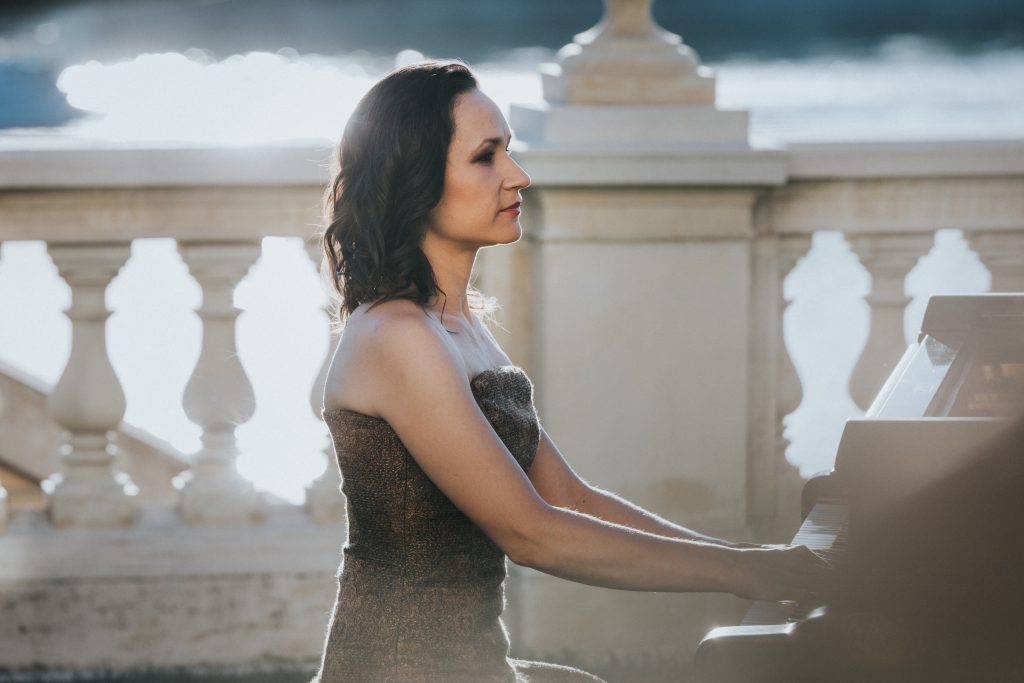
Pianist Éva Polgár (evapolgar.com) will tour four key cities in the US with her program EVOCATION, bringing the spirit of Hungary and Central Europe to American audiences through the compositions of Liszt, Debussy, and Kodály. As the Hungary Foundation’s Cultural Ambassador of the Year, Ms. Polgár will play the following concerts, celebrating the 140th birth anniversary of Hungarian legend Zoltán Kodály, as well as the 160 years since the birth of French composer Claude Debussy.
Kicking off the tour will be her October 2, 3 pm performance at Evanston’s esteemed Nichols Concert Hall, 1490 Chicago avenue, Evanston IL. The program will include Claude Debussy’s First arabesque and L’isle joyeuse; Zoltán Kodály’s Méditation sur un motif de Claude Debussy, Dances of Marosszék, and three movements of his Seven Piano Pieces, Op. 11; and finally, four works by Franz Liszt: Les jeux d’eaux à la Villa d’Este, Sursum corda. Erhebet eure Herzen, and Legende No. 1 and 2. Tickets are $10-30 and are available at evapolgar.ticketleap.com.
This event will be co-presented by the Chicago/Midwest Chapter of the American Liszt Society (ALS) and the Los Angeles International Liszt Competition.
Further stops on the tour will include:
• October 23, 2022, at 2 pm – Los Angeles, The Nixon Library – marking the release of Ms. Polgár’s new album of works by Liszt.
• December 1, 2022, at 7:30 pm – Washington, D.C. – The Arts Club of Washington
• December 15, 2022, at 8 pm – NYC, Carnegie Hall – Weill Recital Hall.
Critics praise Éva Polgár for her “intelligent interpretations” (Funzine Magazine), “emotional power” (New York Concert Review), and “vibrant technique” (American Hungarian Journal). She is a sought-after recitalist, concerto soloist, chamber musician, recording artist, educator, and adjudicator. Beyond her devotion to performing traditional piano repertoire, her creative personality particularly shines through her work in contemporary music and multidisciplinary arts. Her interest in the fusion of the arts has developed into an extensive collaboration with visual artist Sándor Vály. Their albums of experimental music inspired by literature and visual arts are released under Ektro Records and broadcast on Finnish national radio. Born and raised in Hungary, Polgár’s dedication to Hungarian culture has led her to specialize in the music of Franz Liszt and Béla Bartók. Her interpretation of Liszt’s piano works was praised by Liszt scholar Alan Walker as “A stunning performance! A real artist!” Her solo album titledLiszt: Harmonies patriotiques et religieuseswas released recently under Hunnia Records. She has appeared on BBC World Service’s program “The Forum: Franz Liszt – Hungarian pianist and painter in sound” as a panelist and expert in the field.
Polgár has toured the Americas, Asia, and Europe. Her latest concerto performances have included appearances with conductors Horst Förster at the Gewandhaus zu Leipzig, Tamás Vásáry at the Danube Palace in Budapest, and David Jacobs at the University of Oregon. She has been recognized as Cultural Ambassador of the Year to Hungary and will give four solo recitals to promote Hungarian and Central European music culture in Chicago, Los Angeles, New York, and Washington, D.C. in Fall 2022. Her Carnegie Hall debut in November 2020 with violinist Kristóf Baráti and clarinetist Bence Szepesi was praised by the New York press. Other recent chamber music concerts at the Bothnia Biennale festival in Seinäjoki, Finland, and at the Hungarian Radio Hall in Budapest, Hungary, featured music of Brahms, Debussy, Bartók, and Bernstein. An avid promoter of contemporary music, Polgár actively collaborates with composers. She recently performed the world premiere of Andrew S. Lloyd’s Préludes Book II, commissioned by the Barlow Endowment for Music Composition.
A graduate of the Franz Liszt University and the Sibelius Academy, Polgár earned her Doctor of Musical Arts degree at the University of North Texas (UNT). She has won top prizes in competitions including the 2012 Los Angeles International Liszt Competition (LAILC). Co-directors since 2017, Katherine Hickey’s and Éva Polgár’s intent is to ensure the successful continuation of LAILC as well as to foster young musicians in the early stages of their professional careers. To support her endeavors in mentoring rising talents and promoting the musical heritage of Franz Liszt, the Hungarian Academy of Arts has awarded her a three-year grant to produce a series of twenty-nine concerts in Europe and the U.S. between September of 2020 and August of 2023.
A committed educator and adjudicator, she has taught masterclasses, presented at festivals, and adjudicated competitions such as the LAILC, the Bogotá International Piano Festival, and the Tulsa University Summer Piano Academy. After holding teaching positions at UNT and at Texas Woman’s University, Polgár has joined the piano faculty at Azusa Pacific University in California. In addition to her teaching appointment at Azusa Pacific University, she is a co-director of the Los Angeles International Liszt Competition and an elected member of the Board of Directors for the Southern California Chapter as well as the national organization of the American Liszt Society.
In two separate sit-down conversations, both composers were kind enough to share about their lives, musicianship, thoughts on their respective pieces, and what it’s like to be part of this 40th annual Pride Bands Alliance Conference.
EVAN WILLIAMS
Premiering THE WORK ‘LoVE WORDS, MAD WORDS‘
I’m in Memphis, and I’ll soon be moving to Boston as I’ll be teaching at Berklee College of Music this fall. But I’m originally from Chicago.
I started with music in fifth grade on trombone. Band has always been a part of me, and eventually I got interested in both conducting and composing. Throughout college, I continued to play trombone, and for a while I was a music education major, because I thought I wanted to be a high school band director. But at a certain point, I felt that I didn’t want to work with kids every day. So I switched over to being a full time composition major, but I’ve continued to play in bands and orchestra whenever I can.
My friend Lee Hartman, who was the head of the commissioning project with Lakeside Pride introduced me to Sweet Home Chicago. I didn’t have too much time to write the piece, so I started from something I previously wrote: a song cycle for countertenor, who was also based in Chicago. When I got asked to write the commission, I drew on my first song from that cycle, and expanded it into this larger piece at about eight or eight and a half minutes. It’s one of those works that I only have performed once, and not even to full performance. So I thought that Sweet Home Chicago would be a way to give new life to that—at least that first movement.
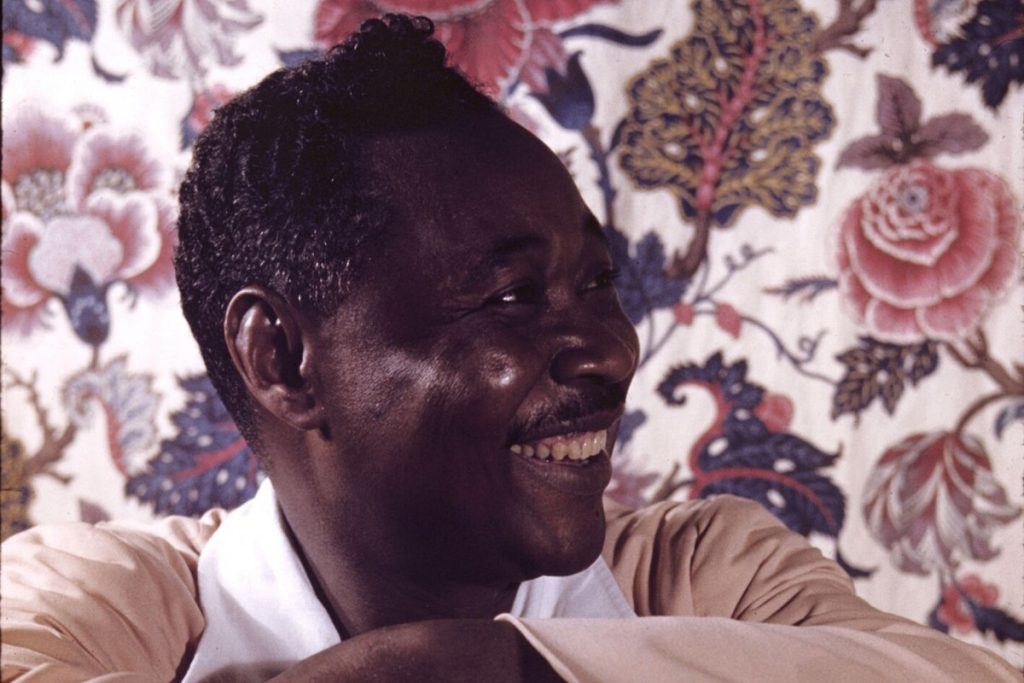
The cycle is called Love Words, Mad Words—and that title comes from a line from the poem “Romance” by Claude McKay. “Love words, mad words, dream words, sweet senseless words; melodious like notes of mating birds.”
Claude McKay, photo by Carl Van Vechten
I originally came across McKay’s writings by searching for Black poets from the Harlem Renaissance. I hate to say it, but all I knew previously was Langston Hughes. And Hughes is notoriously hard to get rights for. In fact, I did get rights for a poem of his that I wrote for another Chicago based ensemble, Quince, but it took almost a year. And so for this commission I needed something that at least was in the public domain.
Interestingly, half of Claude McKay’s poems are in the public domain. I really was drawn to these poems, and to his life: McKay was a Harlem Renaissance poet who spent his last years in Chicago, who was also bisexual, and who I feel like I have a lot of things in common with. Like him, I’m also bisexual — it’s something I’ve been embracing over the last four or so years. And that’s another reason why I was drawn to McKay, and also that he was very politically left like I am. So for a lot of reasons, I thought, “Wow, I should get to know the works of this person.”
Although McKay’s not the most visible of the Harlem Renaissance poets, I still think he is very well known and loved. One of his most famous poems is “If We Must Die”, and it’s quoted a lot. One day, I was watching Judas and the Black Messiah—it takes place in Chicago, and it’s about the Chicago Black Panthers—and they’re just yelling the poem. I thought “Wait a minute. That’s Claude McKay!”
Love Words… is probably the sixth or seventh band piece that I’ve written. What was different about this though, is I’ve never written for a conference. They’d asked me to include a lot of instruments that I’ve never written for before. So, I wrote for alto clarinet and concert bass clarinet, and all different types of clarinets, and at the time, I didn’t yet know what transposition they play in.
I’ll be at least one rehearsal, and then I’ll be at the performance. I am excited to hear it soon, as there’s going to be a lot of people playing this piece at the concert!
I’m 21, and from Maryland. I’m from a very small town called Saint Leonard in Calvert County. Very rural, not much to do around there, an hour or so south from the Baltimore/DC area, I go to University Maryland in College Park, Maryland and I plan on graduating in the Spring of 2023. And I hope to go to school for film scoring.
I’ve been into music from a really young age. My parents are musicians—not professionally, but interested in music since they were really young, and they still play. My mom plays piano, my dad plays saxophone, and they do church gigs every now and then. So, for me and my older sister who plays violin—it was expected of us to do music.
Around third grade, they kind of gave the option to choose an instrument, and because my mom wanted me to play violin like my sister, and I wanted to be different, I chose trumpet, and played that for a couple of years. Some time in middle school, my band director suggested for me to switch to French horn. So when I was 13, in 8th grade, I started to get more serious, I was devoted to practicing, and I was thinking maybe I should take lessons, and get into music school.
When I first talked to Melissa Terrell from Lakeside Pride about this commission, where she wanted to go with the piece, I asked her if she had any requests or specific notes. And she suggested to have some sort of connection to Chicago, or some sort of reference to Chicago. And I don’t really know anything about Chicago, because I’ve just lived in Maryland my whole life. (laughs)
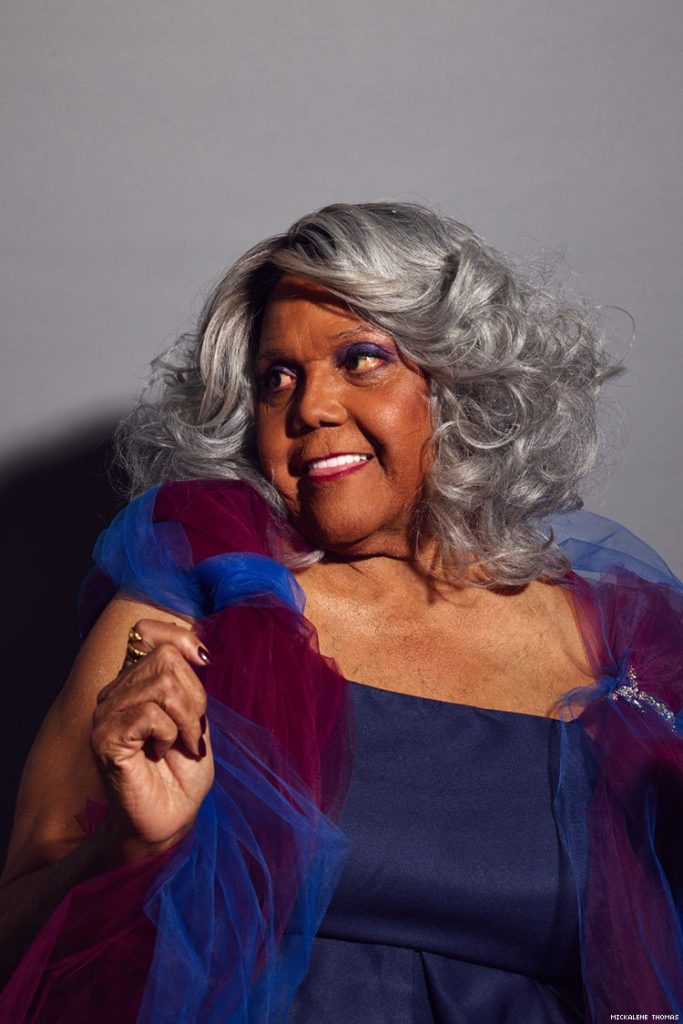
Miss Major Griffin-Gracy, photo by Mickalene Thomas
This concert will be my first time in Chicago, and I’ll be traveling with my sister for the event, and then my parents are going to be flying in for the concert day. The only time I’d been to the Midwest was to Detroit a few times. So in researching for the piece, I looked up Chicago Pride specifically and Queer History in Chicago. And then I found Miss Major Griffin-Gracy.
She was a Trans activist from Chicago, and a part of the Stonewall Riots. I think that was really interesting because we talk so much about Marsha P. Johnson. I kind of feel like that’s kind of the ‘staple name’ for that time period in Trans activism, but it’s important to know other names too. That was the thing that clicked, the spark of inspiration for the piece. I thought, “Oh! That’s a pretty unique name. I feel like I don’t really see that often.” And it’s symbolic. A mythological griffin is symbolic for bravery or strength.
This is my second time writing for a band. I’m most used to writing for chamber works, so it’s definitely challenging in terms of keeping track of all of the lines and staves, all the little moving parts, engraving, and technical things can be a bit difficult. But sometimes, in terms of writing the music I almost find it easier. Because I really like creating warm harmonies and textures, and that’s easier to do with more instrumentation. I have an advantage because I’ve played in band for so long. I was one of those students who wanted to overachieve in music, especially because my music programs in high school and middle school weren’t well-funded. I just wanted to do as much as I could: take lessons, do honor bands, and marching band.
Griffin runs little over seven and a half minutes. I knew I wanted the piece to be celebratory, more lighthearted and upbeat. I wanted to convey this duality; to have some sort of contrast of this bravery, and this strength, and kind of this more grandiose element, and then the opposite of this kind of more slower, somber element. Overall, my goal was to not only represent the griffin as a mythological creature, but also this other symbolic side. How does this relate to Queerness, and can I as a Queer person be powerful and be uplifted? And how can I deal with these moments that are also more serious, and struggles.
I was definitely very excited about the opportunity in general, to be able to attend this conference, and to write this piece. I know it’s a Queer organization, and I thought, “Oh! This is really cool!” But now that I’m actually thinking about it, I’d say that it means a lot, because I definitely—along with many other Queer people—have struggled with internalized and external homophobia. So being recognized not only as a musician, but a Queer musician, is definitely really important.
It’s important that people are able to see what I can do—that Queer people are able to see what I can do.






You must be logged in to post a comment.